
Skip to content
cjhaas blog

Basically a place that Chris can post solutions to problems so he can easily find them later

cjhaas blog

Basically a place that Chris can post solutions to problems so he can easily find them later

Chrome and PDFs requiring web authentication showing only the first page, then dots

Posted on October 14, 2020October 14, 2020 By [email protected]

Recently a user told us that only the first page of their PDF was showing, and all subsequent pages were just showing as tiny dots:

Screenshot of a broken PDF that only shows the first page, followed by dots

After a little debugging we found an issue with Chrome that was related to this.

To reproduce the bug the following must be true:

  1. The PDF must require a cookie to access (for instance, by using the Drupal private file system).
  2. The browser must be set to render the PDF instead of downloading it
  3. The PDF must be saved with linearization (“Optimize for fast web view”)

Ultimately, when Chrome detects a linearized PDF it treats the file more like a movie than an arbitrary binary object, and after getting the first page, it issues HTTP Range Requests for more pages in order to (appear to) speed things up. Unfortunately, these additional range requests don’t appear to include the cookie which results in a server error, probably a 403 if you have things setup correctly. You should be able to tail your logs to find the multiple requests, and the duplicates will list the file itself as the referer.

example.org 127.0.0.1 - - [14/Oct/2020:15:57:11 -0500] "GET /system/files/documents/file.pdf HTTP/1.1" 200 12607446 "https://example.org/page/x/y/z" "Mozilla/5.0 (Windows NT 10.0; Win64; x64) AppleWebKit/537.36 (KHTML, like Gecko) Chrome/86.0.4240.75 Safari/537.36"
example.org 127.0.0.1 - - [14/Oct/2020:15:57:12 -0500] "GET /system/files/documents/file.pdf HTTP/1.1" 403 26966 "https://example.org/system/files/documents/file.pdf" "Mozilla/5.0 (Windows NT 10.0; Win64; x64) AppleWebKit/537.36 (KHTML, like Gecko) Chrome/86.0.4240.75 Safari/537.36"

The only fix that we would so far is to re-save or re-export without linearization. You can do that from Acrobat by performing a File, Save as Other, Optimized PDF. In the window that opens, uncheck everything on the except “Clean Up”, and for that option uncheck all of the settings:
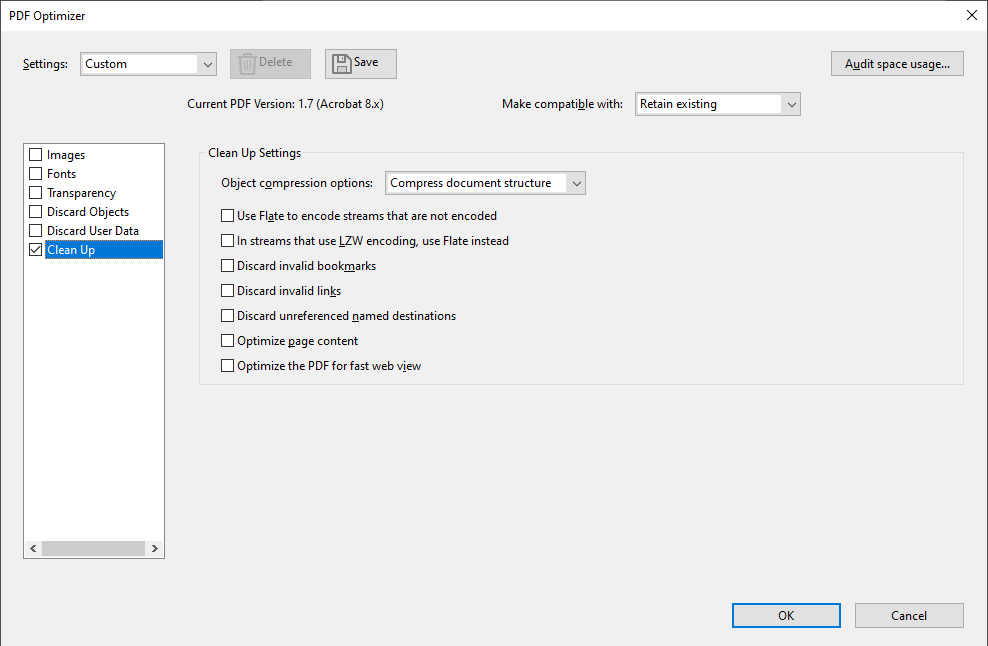
Options to disable linearization when saving a PDF

If you want to know if a file has linearization applied to it you can open it a hex editor like XVI32, and in the first could of dozen bytes look for <</Linearized.
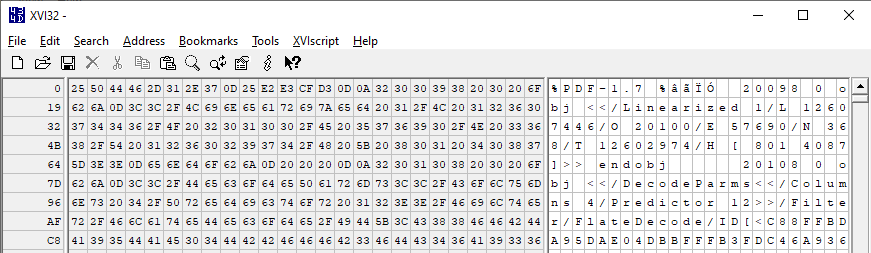
Hex dump of a PDF showing that it is linearized

Drupal PDF

Post navigation

Previous post
Next post

Leave a Reply Cancel reply

Your email address will not be published. Required fields are marked *

This site uses Akismet to reduce spam. Learn how your comment data is processed.

Recent Posts

  • Google open redirect
  • How to use AI to write code
  • Doctrine/Symfony MariaDB DSN connection string
  • Creating a portable copy of pdftotext from source
  • Gravity Forms shortcode getting extra line breaks when used with ACF

Recent Comments

  • jose luis on #2 – VB.Net iTextSharp Tutorial – Add an image to a document
  • Eliezer Castanon on iTextSharp slightly smarter text extraction strategy
  • javad on How to recompress images in a PDF using iTextSharp
  • MANOUS3784 on Flock is awesome
  • Sang on Flock is awesome

Archives

  • June 2026
  • October 2025
  • November 2023
  • September 2023
  • July 2023
  • June 2023
  • May 2023
  • April 2023
  • December 2022
  • September 2022
  • April 2022
  • October 2021
  • September 2021
  • April 2021
  • January 2021
  • October 2020
  • August 2020
  • June 2020
  • May 2020
  • December 2019
  • November 2019
  • October 2019
  • July 2019
  • May 2019
  • December 2018
  • October 2018
  • July 2018
  • November 2017
  • October 2017
  • August 2017
  • July 2017
  • June 2017
  • May 2017
  • April 2017
  • March 2017
  • February 2017
  • January 2017
  • September 2015
  • December 2014
  • November 2014
  • October 2014
  • September 2014
  • August 2014
  • July 2014
  • November 2013
  • May 2013
  • April 2013
  • March 2013
  • January 2013
  • November 2012
  • October 2012
  • July 2012
  • March 2012
  • January 2012
  • October 2011
  • September 2011
  • July 2011
  • February 2011
  • December 2010
  • November 2010
  • October 2010
  • September 2010
  • August 2010
  • June 2010
  • April 2010
  • January 2010
  • December 2009
  • November 2009
  • October 2009
  • July 2009
  • June 2009
  • May 2009
  • April 2009

Categories

  • Accessibility
  • Advanced Custom Fields
  • Authorize.Net
  • BWP Minify
  • Composer
  • Crappy Google Search Results of the Day
  • CSS
  • Doctrine
  • Drupal
  • Drush
  • Elasticsearch
  • Fun links of the day
  • Google Analytics
  • Gravity Forms
  • HHVM
  • HTML
  • iTextSharp
  • JavaScript
  • Linux
  • mysql
  • nginx
  • Optimization
  • PDF
  • PdfPTable
  • PHP
  • Plugins
  • Ramblings
  • Random things I learned
  • Redis
  • Security
  • simplesamlphp
  • SQL Server
  • SSH
  • SSL/TLS/HTTPS
  • Stack Overflow
  • SVG
  • Symfony
  • Synology
  • Uncategorized
  • Unicode
  • Varnish
  • Vendi Best Practice
  • VIP
  • Weird Google Search Results
  • Windows
  • WordPress
  • WP-CLI

Meta

  • Log in
  • Entries feed
  • Comments feed
  • WordPress.org
©2026 cjhaas blog | WordPress Theme by SuperbThemes